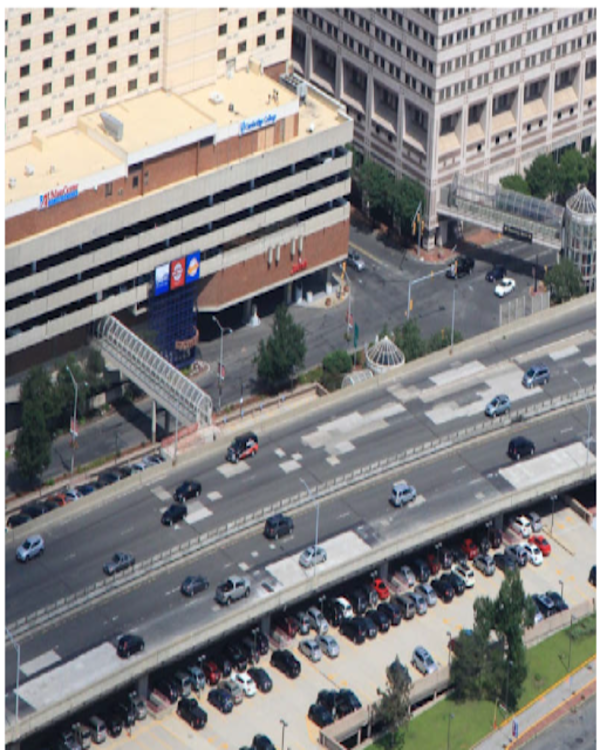
The case study described in this article involves a segment of I-91 in Springfield, Massachusetts, which was 50 years old at the time and owned and maintained by MassDOT. This section of I-91 was built in the late 1960s, meaning it had nearly reached its anticipated 50-year lifespan.
The elevated roadway spans about 4,400 feet long, with three traffic lanes in each direction. The northbound section consists of 67 spans with 321,000 square feet of bridge deck. The southbound section consists of 62 spans with 293,000 square feet of bridge deck. Before repair work began, the bridge carried an average of 72,000 vehicles per weekday and 54,000 vehicles on weekends. The maximum traffic of 5,700 vehicles per hour occurred during weekday afternoons. At the time of the SHM program, annual maintenance costs for these sections of the road had reached $2 million and were increasing.
At a minimum, the bridge deck needed to be replaced. Visual inspections and analysis had judged that many structural elements critical to the bridge’s safety were potentially structurally deficient, so action was required. A complete replacement was considered, but this would be time-consuming, would cause significant negative impacts, and had an estimated cost of $800 million.
CME Associates, a municipal consulting and engineering firm, led a team to plan a sequential bridge deck replacement using Accelerated Bridge Construction to minimize mobility impacts on travelers. By using prefabricated bridge deck elements, traffic could remain moving during construction, the bridge’s life could be extended for at least 20 more years, and the estimated cost would be about $260 million—around one-third the cost of a full replacement. No issues with the foundations or substructures were known, so this was an attractive alternative if the concerns with the main structural elements could be addressed. These concerns included excessive stress on the main beams with partial-length deck plates and critical fracture steel cover plates between the main longitudinal beams.
Almost all spans contained cover plates with critical fractures extending between the pillar columns and were framed in the main longitudinal beams with bolted connections. There had been a history of minor cracking due to fatigue in these cover plates where they framed in the impost beams. This behavior was determined to be caused by an incomplete connection, resulting in out-of-plane bending.
Although this project deals with bridge structure, it also has lessons for geotechnical engineers. First, measuring in-service performance can help engineers evaluate calculations and determine real conditions to improve predictive models and provide more confidence in our knowledge of real conditions. This can reduce conservatism in decision-making. Second, measured performance can help assess the condition of structures approaching the end of their design life to determine how much life is left and what can be done to extend that life. Third, technology now exists to collect large amounts of performance data in ways that help separate the effects of sudden loads, environmental changes, and long-term degradation, so that a comprehensive evaluation of in-service performance can be made. Much of what was previously thought to be noise in measurements can now be seen as a combination of these various effects.
Our huge amount of aging infrastructure presents significant challenges for owners, engineers, and contractors in finding ways to extend the useful life of many of these existing facilities instead of demolishing and replacing them. In-service measurements of the performance of load-bearing elements of a facility can provide much information about current performance and safety levels. These measurements, along with proper analysis and evaluation, can often provide a reliable way to perform quantitative assessments of load levels, performance levels, and remaining useful life. The results may show that a critical component for the safe performance of the facility has much more useful life left than a visual inspection might indicate. Alternatively, measurements may show how to reinforce the element economically to extend its life.
This approach is what I call Structural Life Extension (SLE). As demonstrated in the I-91 project, SLE can provide significant savings to owners by safely squeezing more life out of a facility than could be achieved with more traditional health assessment systems based on visual inspections. This approach has recently become a practical possibility with the development of high-performance data acquisition, management, and processing systems that are relatively affordable. These systems can be implemented in the field and operate on battery power, making them practical and cost-effective tools for this application.
However, a few words of caution are appropriate. These systems and their application are reasonably simple to understand and implement, but they require careful and meticulous work in all aspects to deliver reliable and useful results. Many strain gauge installations do not provide reliable data because the proper procedures were not followed. Common errors include not properly preparing the surface of the member, not properly fixing the gauge, using materials unsuitable for the weather conditions, not protecting against moisture ingress, not addressing voltage drop in main lines, electrical noise in the system, and improperly attaching and securing cables. Processing large amounts of data without errors can also be challenging, and detecting and removing errors can be difficult and time-consuming. Providing reliable data so that engineers evaluating them can focus on what they mean rather than whether they are good or not is an essential requirement for using monitoring systems for SLE applications. If done correctly, the results can be more satisfying when the team can tell the owner that their facility has many more years of useful life.