
Rigid Inclusions in Soft Soils:
How to Build on Peat and Highly Compressible Clays

How do rigid inclusions save time and money?

Building on soft soils, peat, or highly compressible clays represents one of the biggest challenges in modern geotechnical engineering. When structural loads are high, conventional solutions can prove costly, inefficient, or technically limited. In this context, rigid inclusions have emerged as a high-value alternative for ground improvement, enabling the foundation of complex structures.
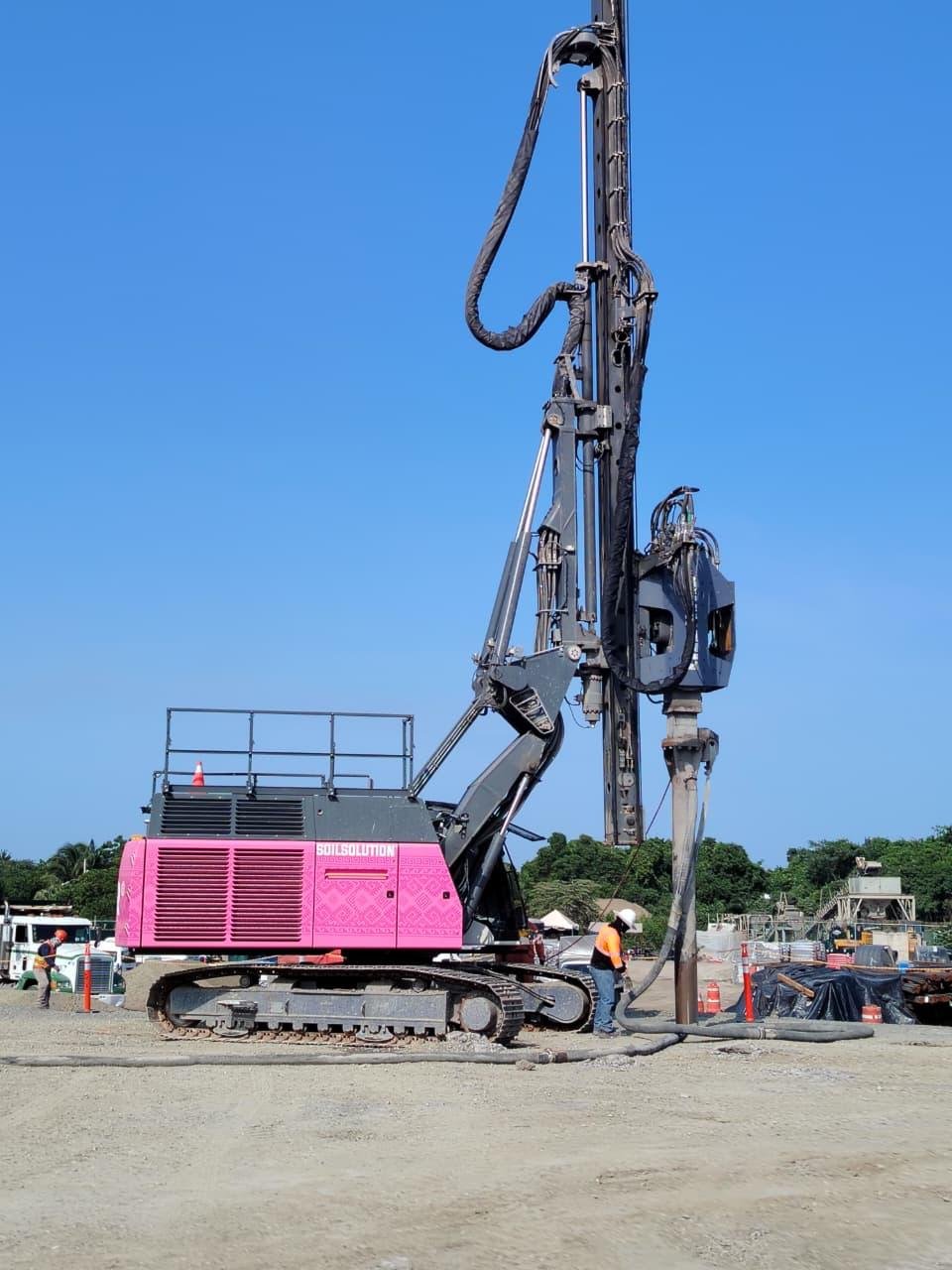
An emblematic case is the development of a 14-story pharmaceutical research building built on a highly compressible peat deposit. The challenge was significant: supporting large-scale infrastructure on a soil profile with low stiffness, high deformability, and unfavorable groundwater conditions. Instead of relying solely on traditional deep foundations, the project demonstrated how rigid inclusions can redefine the limits of what we consider “buildable land” today.

Why Rigid Inclusions Are an Effective Solution in Soft and Organic Soils

Rigid inclusions are high-stiffness elements installed in the ground to improve load-bearing capacity and reduce settlements in compressible soils. Their main function is not to act as a conventional structural pile, but to work in conjunction with the soil and a transfer platform to redistribute loads from the superstructure to more competent strata.

This principle is especially useful in soft and organic soils, where natural materials exhibit low shear strength, high compressibility, and time-dependent behavior. In these scenarios, rigid inclusions help control deformations and optimize the performance of the soil-foundation system.

The Challenge of Building on Soils That Behave Like "Jelly"

Some organic soils, such as peat, exhibit extremely compressible behavior. From an engineering perspective, this means that their ability to support high loads without excessive deformation is very limited. When building a tall building or a structure with significant loads on top of these deposits, the problem is not just resistance but also total and differential settlements.

In the analyzed case, the project had to support approximately 450,000 square feet of infrastructure on a particularly unfavorable soil profile. The presence of a peat layer, combined with sands and silts of varying density and a shallow water table, forced the dismissal of several traditional alternatives. It was precisely here that rigid inclusions proved their potential.

Why Traditional Gravel Piers May Be Insufficient in Organic Soils

For decades, densified aggregate columns have been widely used to improve ground conditions. However, their performance heavily depends on the lateral confinement provided by the surrounding soil. In soft soils or those with significant organic content, this condition becomes critical.

When the soil does not offer sufficient confinement, granular columns can experience lateral bulging, losing their effectiveness as vertical support elements. In other words, the granular material tends to expand into the soft soil under high loads, which limits its bearing capacity and increases the risk of excessive deformations.

Rigid inclusions address this problem by incorporating a much higher intrinsic stiffness, typically through cemented or concrete elements. As a result, they no longer rely on the same degree of lateral confinement from the soft soil to maintain their structural integrity. This allows the load to be transferred more efficiently to deeper layers with better mechanical properties.

Rigid Inclusions for Supporting Heavy Structures

One of the greatest benefits of rigid inclusions is their ability to make the construction of heavy structures feasible on land that would otherwise require much more expensive deep piles or massive soil replacement processes.

In the analyzed project, the load magnitudes were significant: isolated footings with demands exceeding 4,100 kips, wall linear loads between 10 and 62 kips per foot, and contact pressures of up to 7.8 ksf, with additional increments due to wind. Under these conditions, conventional shallow foundations were dismissed due to the high cost of removing the peat and the complexity associated with groundwater control. Traditional piles were also not competitive due to the required lengths.

Rigid inclusions offered a highly efficient intermediate solution: improving the ground for foundation acceptance, reducing settlements, and avoiding a deeper, more expensive piling solution.

A Complex Case: Building on Soft Soil and an Active Highway

The complexity of the project was not only in the soil. The structure was being developed on an active highway located in a depressed level, which required a particularly demanding foundation configuration. The building required a highly loaded central core and lateral foundation zones that would work complementarily to stabilize the overall response of the structure.

Geotechnically, the terrain profile included granular fills, a variable-thickness peat layer, and a deep deposit of sand and silt. The SPT resistance values were relatively low within the first 50 feet, confirming the need for a reliable improvement system. In this context, rigid inclusions allowed for the development of a technically feasible and constructively efficient solution.

The Role of the Transfer Platform in Rigid Inclusions Systems

In a rigid inclusion system, the transfer platform is an essential component. This element, typically composed of compacted granular material and sometimes reinforced with geogrids, is placed between the shallow foundation and the inclusion heads to facilitate load redistribution.

Its technical function is fundamental for several reasons:

  • It helps reduce the direct transfer of lateral stresses to the heads of the inclusions. 
  • It provides a deformable transition zone that enhances interaction between the soil, inclusions, and the structure. 
  • It favors the concentration of stresses on the rigid elements through the well-known arching effect, allowing a larger proportion of the load to be carried by the inclusions, not the surrounding soft soil. 

In the analyzed project, pressure measurements showed precisely this behavior: the soil matrix absorbed a very small fraction of the effort, while the rigid inclusions received most of the load. This evidence confirmed the effectiveness of the transfer system.

The Arching Effect: The Key to Rigid Inclusions' Performance

The arching effect is one of the most important mechanisms for understanding how rigid inclusions work. When there is a significant stiffness difference between the inclusions and the surrounding soft soil, the load tends to redistribute toward the stiffer elements. As a result, the compressible ground participates less in directly supporting the structure.

From a design perspective, this phenomenon allows for the reduction of settlements and improves system behavior, provided the geometry, spacing, stiffness of the inclusions, and transfer platform properties have been correctly defined.

Quality Control in Rigid Inclusions: Precision During Installation

Another key aspect of the case was quality control during the installation of rigid inclusions. The system used a closed displacement mandrel loaded with concrete before installation. Because the system’s volume remains controlled, pressure monitoring allowed for the accurate estimation of the volume of concrete placed during the formation of the element and its base bulb.

This type of instrumentation represents a significant advantage because it allows for the verification of shaft continuity and proper element formation during execution. In rigid inclusion systems, where the element’s reliability is critical for the overall performance, having objective measurements during installation greatly improves design certainty.

Load Testing Results: How Rigid Inclusions Perform in the Field

To validate the solution, a full-scale load test was performed up to 900 kips. The results showed favorable system behavior. At the design load of 150 kips per column, the observed deformation was only 0.1 inches, confirming the high efficiency of rigid inclusions in controlling settlements under service loads.

However, the test also provided an important technical lesson: when effort levels were very high, the transfer platform itself contributed significantly to the total settlement due to its internal compressibility. This led to the conclusion that, for tall structures or very high loads, the thickness of the transfer platform should be optimized so that the inclusions’ stiffness more clearly governs the system’s response.

Advantages of Rigid Inclusions Over Other Foundation Alternatives

Rigid inclusions offer significant advantages when compared to other ground improvement or foundation solutions in soft soils:

  • Reduction of Settlements: By concentrating more load on high-stiffness elements, rigid inclusions help reduce both total and differential deformations. 
  • Less Dependence on Lateral Confinement: Unlike granular columns, rigid inclusions maintain their capacity without critically depending on lateral effort from soft soil. 
  • Feasibility in Organic Soils: In peat, very soft clays, or compressible alluvial deposits, rigid inclusions may be more reliable than conventional granular methods. 
  • Technical-Economic Optimization: In certain projects, rigid inclusions allow for avoiding more expensive and complex deep pile solutions. 
  • Compatibility with Shallow Foundations: When properly designed, rigid inclusions can integrate with footings or slabs, improving overall behavior without necessarily resorting to a traditional piling system.

Applications of Rigid Inclusions in Geotechnical Engineering

Today, rigid inclusions are used in a wide variety of projects:

  • Buildings on soft soils 
  • Embankments and platforms over compressible deposits 
  • Industrial warehouses 
  • Tanks and storage structures 
  • Urban developments in areas with fills or organic materials 
  • Infrastructure built on soft clays or alluvial soils 

Their use has grown because they enable more efficient handling of terrains that were once considered technically unbuildable or economically unattractive.

What Rigid Inclusions Teach Us About the Future of Geotechnical Engineering

The success of these solutions leaves a relevant reflection for professional practice. In an urban environment where available soil is often of lower quality and projects demand ever higher loads and lower deformations, the ability to build on difficult terrains will largely depend on technologies such as rigid inclusions.

Beyond the specific case, the message is clear: the frontier of urban development no longer depends solely on finding “good soil,” but on the ability of geotechnical engineering to transform problematic soils into safe, functional platforms.

Conclusion

Rigid inclusions have proven to be a highly effective solution for building on peat, soft clays, and other highly compressible soils. Their ability to redistribute load, activate the arching effect, reduce settlements, and work in conjunction with shallow foundations makes them a highly valuable alternative for demanding projects.

When conventional solutions are limited by cost, depth, or performance, rigid inclusions open up a new possibility: making what was once considered unbuildable, constructible.

In geotechnical engineering, often the most important innovation is not what is visible on the ground, but the intelligence with which we modify what happens beneath it.

By Ph.D. Carolina Hernández Valerio

Frequently Asked Questions
About Rigid Inclusions

Rigid inclusions are high-stiffness elements installed in the ground to improve load-bearing capacity and reduce settlements in soft or compressible soils.

They help transfer loads to more competent strata, improve the soil-foundation system’s behavior, and make it feasible to build on problematic terrains.

Not exactly. Although both are deep elements, rigid inclusions work as part of a system with the soil and a transfer platform, whereas traditional piles are usually designed as structural elements that transfer load more directly.

Rigid inclusions are especially useful in peat, soft clays, heterogeneous fills, compressible alluvial deposits, and other soils with low stiffness or high deformability.

The main advantage is that rigid inclusions are not as dependent on lateral confinement from soft soil, allowing them to perform better under high loads in organic or very compressible terrains.

Scroll al inicio