
Rammed Aggregate Piers vs Rigid Inclusions: Which is the Best Soil Improvement Solution?

Which is the right choice for your project?

When it comes to building on weak or soft soils, one of the first critical decisions in geotechnical engineering is choosing the right soil improvement technique. Two widely used solutions in this field are rigid inclusions and rammed aggregate piers.

But… which one is the best fit for your project? Which is more cost-effective, faster, or more durable?

In this blog, we’ll walk you through a comparison of both solutions without unnecessary technicalities, helping you choose the best option for your construction needs.
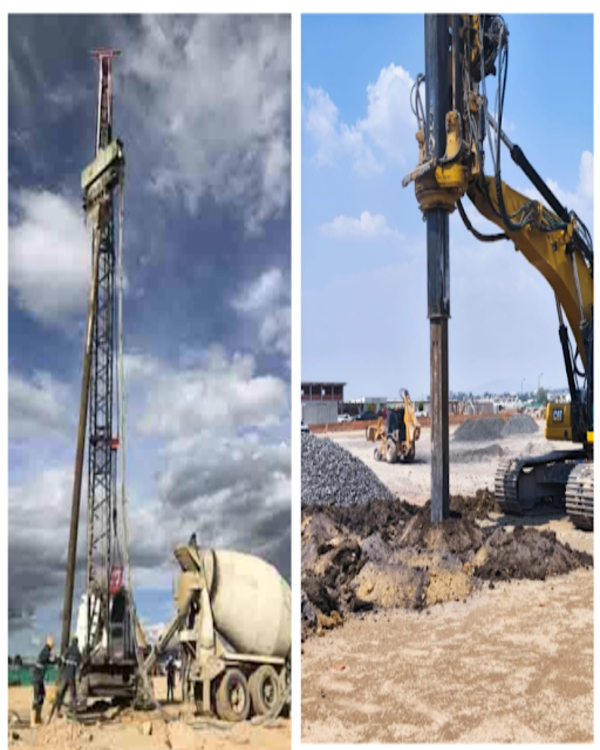
What are Rigid Inclusions?

Rigid inclusions are vertical concrete elements, typically without reinforcement (although they may have some), that are introduced into the ground to improve its strength and stiffness. They act as hidden pillars that transfer loads from the structure to more resistant layers of soil.

They are installed using specialized machinery, such as pile drivers or drilling rigs, and are complemented by a distribution layer on top to ensure uniform load distribution.

What are Rammed Aggregate Piers?

Rammed aggregate piers are vertical columns made up of gravel layers, inserted into the ground and compacted using vibratory energy.

Unlike rigid inclusions, they do not use concrete or steel, making them a more eco-friendly, flexible, and cost-effective option. Additionally, the compaction improves not only the load-bearing capacity but also the density of the surrounding soil.

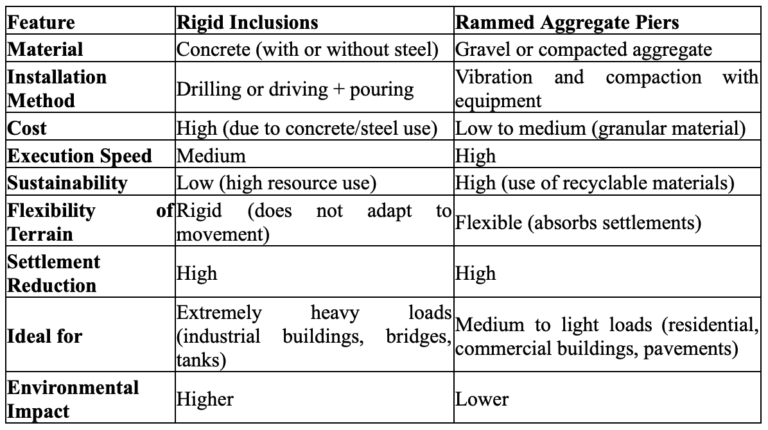
Technical Comparison: Rigid Inclusions vs Rammed Aggregate Piers

Here’s a clear comparison of how these two techniques stack up:

Which is the Best Solution?

It depends on several factors. Here’s a guide to help you make the best decision based on project conditions:

Choose Rigid Inclusions if:

  • You’re building a structure with very high loads (industrial buildings, bridges, tanks). 
  • The soil is extremely soft or clayey and does not allow efficient compaction. 
  • You don’t have major budget or time constraints. 

Choose Rammed Aggregate Piers if:

  • The project involves residential buildings, light commercial buildings, industrial parks, or pavements. 
  • You’re looking for an economic and quick solution. 
  • You care about the environmental impact or want to use recyclable materials. 
  • You want to minimize vibrations and avoid deep drilling.

Additional Benefits of Rammed Aggregate Piers

  • Greater quality control during execution 
  • Lower carbon footprint 
  • Compatibility with heterogeneous soils 
  • No need for reinforcement or special structures 
  • Faster and less machinery time on-site

Final Thoughts

Rigid inclusions and rammed aggregate piers are not competing techniques but distinct solutions for different needs. While rigid inclusions offer extreme rigidity and support, rammed aggregate piers provide flexibility, efficiency, and sustainability, especially for medium-sized urban, commercial, or industrial projects.

Scroll al inicio