Monitoring MSE Walls with Rammed Aggregate Piers: A Success Case in Texas

Discover how the Rammed Aggregate Pier system improved stability and reduced settlements in MSE walls

The monitoring of mechanically stabilized earth (MSE) walls supported by the Rammed Aggregate Pier (RAP®) system in Texas demonstrates the effectiveness of this technology in soft soils. In this blog, we explore the results from geotechnical monitoring instrumentation and the observed benefits in terms of stability and settlements.
Introduction

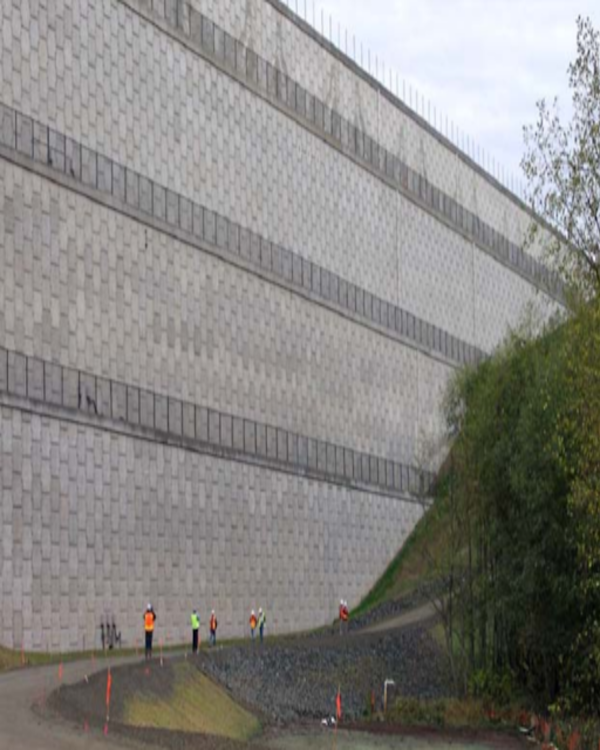
Building infrastructure on low-bearing capacity soils represents a significant challenge in civil engineering. In Texas, the expansion of the interchange between US-90A and State Highway 6 required the installation of MSE walls as high as 8.2 meters.

The Problem: The soft clay soils in the area posed risks of global instability, differential settlements, and low bearing capacity. To address this without deep excavation or prolonged pre-loading, the Texas Department of Transportation (TxDOT) and the design team opted for the use of Rammed Aggregate Piers.

This blog explores the design, instrumentation, and monitoring of MSE walls supported by the RAP® system, highlighting the benefits in terms of stability and settlement control.

Soil Conditions and Geotechnical Challenges

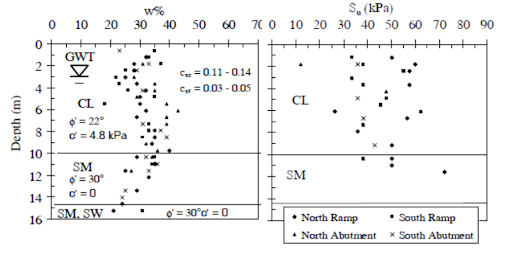
Before construction, a geotechnical study identified the following soil conditions in the project area:

  • Soft to medium clay within the first 9-12 meters. 
  • Loose to moderately dense sandy silts between 15-18 meters. 
  • Medium to high-density sand at deeper layers. 
  • Groundwater level found at 3 meters depth. 

These soft clay soils made the MSE walls unstable and represented a significant risk for differential settlements.

Design and Construction with Rammed Aggregate Piers

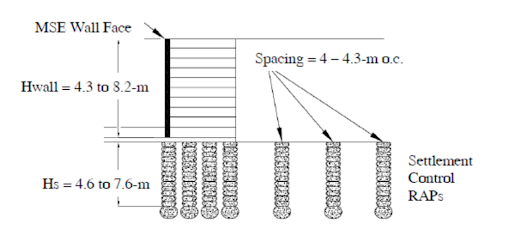
To improve bearing capacity and reduce settlements, a Rammed Aggregate Pier system was installed with the following characteristics:

  • Distribution: Densely spaced piers beneath the walls and in the reinforcement zone. 
  • Depth: Up to 7.6 meters, penetrating the soft clay to reach firmer layers. 
  • Main Function: 
    • Increase load-bearing capacity by reinforcing the soil with high-friction aggregate. 
    • Reduce settlements by enhancing soil rigidity. 
    • Accelerate consolidation by providing drainage paths for pore water dissipation. 

A total of 1411 piers were installed across four sections of the project in a process that took eight months.

Instrumentation and Performance Monitoring

To assess the effectiveness of the RAP system, a geotechnical monitoring program was implemented, funded by the Federal Highway Administration (FHWA).

Instruments Used:

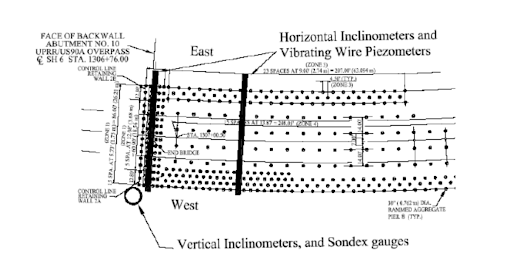
  • Vertical and Horizontal Inclinometers: To measure lateral displacements in the walls. 
  • Vibrating Wire Piezometers: To monitor pore pressure in the soil. 
  • Sondex Settlement Gauges: To record vertical deformations. 

Instrumentation was installed at the most critical sections of the walls, and monitoring was conducted for approximately one year.

Monitoring Results

The data collected demonstrated that the performance of the MSE walls with Rammed Aggregate Piers was satisfactory across all measured parameters:

Vertical Settlements:

  • Maximum settlement recorded: 5 cm (2 inches), within the design limit. 
  • Post-construction settlement: Less than 1.5 cm (0.5 inches), indicating early stability. 
  • Stabilization speed: The walls reached stability in less than 6 months after construction. 

Lateral Displacements:

  • Maximum lateral displacement recorded: 3.2 cm (1.25 inches) in the highest section (8.2 m). 
  • Average displacement: 1.25 cm (0.5 inches) in the rest of the walls. 
  • Effect of the Rammed Aggregate Piers: Higher rigidity and control of lateral deformation. 

Pore Pressure:

  • Rapid dissipation of excess pore pressure, aided by the drainage function of the Rammed Aggregate Piers. 
  • Minimal impact from intense rainfall, thanks to the drainage capacity of the system. 

These results confirmed that the technology met the stability and settlement control criteria established in the design.

Conclusions and Benefits of Rammed Aggregate Piers in MSE Walls

The use of Rammed Aggregate Piers in this infrastructure project in Texas proved to be an efficient and cost-effective solution for improving the stability of MSE walls on soft clay soils.

Key Observed Benefits:

  • Increased bearing capacity without the need for deep excavation. 
  • Reduction of settlements to acceptable levels (<5 cm). 
  • Rapid soil stabilization in less than 6 months. 
  • Less lateral displacement compared to traditional solutions. 
  • Efficient drainage, minimizing the impact of pore pressure. 

These findings support the viability of the RAP® system as an effective alternative for improving the stability of infrastructure in problematic soils.

By: Ph.D. Carolina Hernández Valerio

References

  • Micnhimer, T., Parra, J.R., & Williamson, T. (2009). Instrumentation and monitoring of MSE walls supported on the rammed aggregate pier system. In Contemporary Topics in Ground Modification, Problem Soils, and Geo-Support (pp. 337-344).
Scroll al inicio