3 Key Differences Between Geopier® Rammed Aggregate Piers (RAP®) and Conventional Stone Columns

Comparing Construction Methods, Performance, and Design for a Better Soil Stabilization Choice

Rammed Aggregate Piers (RAP®) by Geopier® and conventional stone columns (SCs) are popular ground improvement techniques used in projects requiring soil stabilization. While both aim to reinforce and improve soil performance, there are key differences in their construction methods, performance, and design approach. Below are three main differences between these technologies.
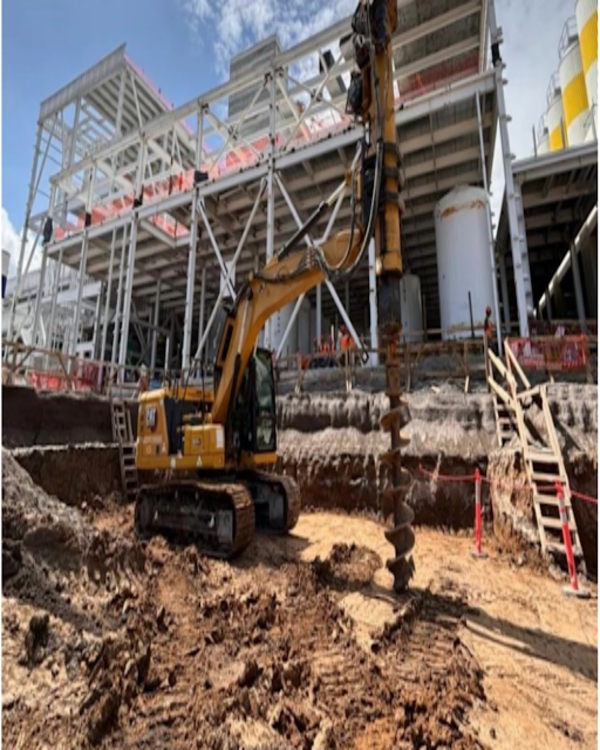
1. Differences in the Construction Method

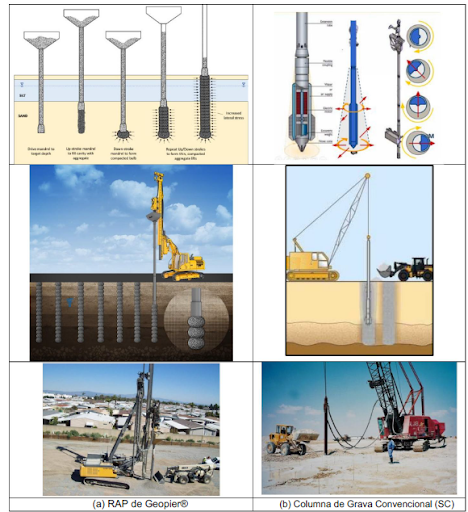
Geopier® Rammed Aggregate Piers (RAP®) are built using a patented method that combines hydraulic pressure, vertical compaction energy, and a controlled compaction system. During construction, a compaction foot allows the aggregate to pass as the mandrel is raised, and as it descends, restricting chains compact the material, creating a tamping effect. This method achieves intense vertical compaction, displacing adjacent soil and densifying the soil matrix, which is critical for reinforcing the structure.

In contrast, conventional stone columns (SCs) employ a vibroflotation method to insert gravel material into the soil. This method, known as vibro-replacement, can be performed from the surface or from the bottom of a drilled hole. Vibroflotation uses vibration to create a stable column but does not generate the same level of vertical compaction and lateral densification in the surrounding soil as the RAP® method by Geopier®.

Figure 1: Construction methods of a) Geopier RAP® (left) vs b) Conventional Stone Columns (SCs, right)

2. Superior Performance of Geopier® Rammed Aggregate Piers (RAP®)

Geopier® Rammed Aggregate Piers (RAP®) exhibit significantly superior mechanical performance compared to conventional stone columns, primarily due to their construction technique. In comparison:

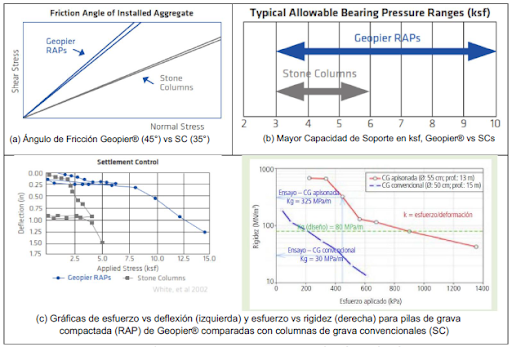
  • Friction Angle: Geopier RAP® piers have a higher friction angle, reaching up to 45°, while conventional stone columns typically only reach 35°. This higher angle allows for greater shear resistance. 
  • Load-Bearing Capacity: RAP® piers can increase load-bearing capacity by up to 40% compared to SCs, meaning they can support higher loads without excessive deformation. 
  • Stiffness: RAP® piers also have significantly higher stiffness, with values ranging from 100 to 300 MPa, compared to the 60 MPa typically seen in conventional SCs. This results in better settlement control under static loads, which is essential in projects involving sensitive structures like wind towers or buildings in seismic zones. 

This enhanced performance also reduces the required replacement area (Ra) by up to 50% to achieve similar liquefaction mitigation levels. For example, the New Zealand government (EQC, 2013) recommends an Ra of just 8-12% for RAP® piers in liquefaction conditions, compared to 16-20% for conventional stone columns.

Figure 2: Mechanical properties of Geopier RAP® vs conventional stone columns (SCs). Source: (a) and (b) own; (c) adapted from X. Vera, Mexican Geotechnical Society, August 2018, Bulletin No. 248.

3. Modern Design Approach Based on Full-Scale Testing

The design methods for Geopier® RAP® piers have evolved to incorporate full-scale testing, demonstrating their effectiveness in high seismicity projects. For RAP® piers, the design is based on the Idriss & Boulanger (2008) methodology, with tests that quantify effectiveness in liquefaction mitigation, increasing lateral stresses, and soil stiffness.

On the other hand, conventional stone columns continue to use the 1995 Priebe method. This design relies on the principle of “shear stress attraction” to theoretically reduce seismic demand. However, recent studies have questioned the reliability of this approach, pointing out that it may not provide an adequate safety factor against liquefaction, especially in high-magnitude seismic events.

Conclusion

In summary, Geopier® RAP® piers and conventional stone columns are not interchangeable or comparable in terms of construction, performance, or design. RAP® piers provide a superior solution for projects requiring high load capacity, stiffness, and effective liquefaction mitigation, allowing for a reduction in the material replacement area without compromising structural safety.

By: Ph.D. Carolina Hernández Valerio

References

  • Amoroso, S., Rollins, K.M., Andersen, P., Gottardi, G., Tonni, L., García Martínez, M.F., Wissmann, K., Minarelli, L., Comina, C., Fontana, D., De Martini, P.M., Mónaco, P., Pesci, A., Sapia, V., Vassallo, M., Anzidei, M., Carpena, A., Cinti, F., Civico, R., Coco, I., Conforti, D., Doumaz, F., Giannattasio, F., Di Giulio, G., Foti, S., Loddo, F., Lugli, S., Manuel, M.R., Marchetti, D., Mariotti, M., Materni, V., Metcalfe, B., Milana, G., Pantosti, D., Pesce, A., Salocchi, A.C., Smedile, A., Stefani, M., Tarabusi, G., Teza, G. (2020b). Liquefaction Induced by Explosions in Silty Sands for Large-Scale Ground Improvement Method Testing: Perspectives from a Multidisciplinary Study. Eng. Geol., 265, 17. DOI 
  • Idriss, I.M., Boulanger, R.W. (2008). Soil Liquefaction During Earthquakes. EERI Monograph MNO12, Earthquake Engineering Research Institute, Oakland. 
  • Priebe, H.J. (1995). Design of Vibro-Replacement Stone Columns. Ground Engineering (December), 31-37. 
  • Rayamajhi, D., Nguyen, T.V., Ashford, S.A., Boulanger, R.W., Lu, J., Elgamal, A., Shao, L. (2012). “Effect of Discrete Columns on Shear Stress Distribution in Liquefiable Soils.” GeoCongress 2012: State of the Art and Practice in Geotechnical Engineering, ASCE GeoInstitute, Oakland, CA, March 25–29. 
  • Rayamajhi, D., Boulanger, R.W., Ashford, S.A., Elgamal, A. (2016). Dense Granular Columns in Liquefiable Soil: Shear Reinforcement and Cyclic Shear Stress Ratio Reduction. J. Geotech. Geoenviron. Eng., 04016023. 
  • Smith, M.E., Wissmann, K. (2018). Soil Reinforcement Mechanisms Determined for the Muisne Earthquake, Ecuador. 5th Geotechnical Earthquake Engineering and Soil Dynamics Conference: Liquefaction Triggering, Consequences, and Mitigation GEESDV 2018, 290, 286-294. Austin, Texas, June 10-13, 2018.
Scroll al inicio